Assembly elections in Kerala, TN, Puducherry on May 16
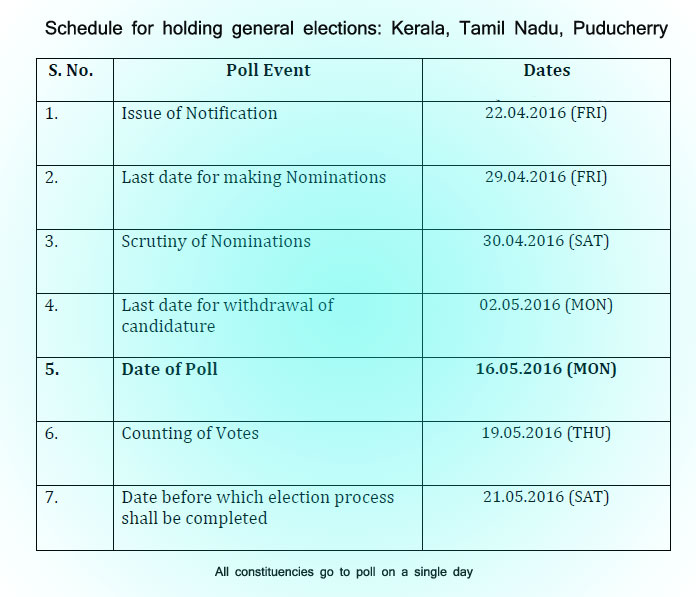
Kerala, Tamil Nadu, Puducherry go to polls on May 16 to elect 140, 239 and 30 members to their respective legislatures.
Elections will be held in West Bengal in six phases. The polling under first phase will take place on April 4 and 11 and the remaining phases on April 17, 21, 25 and 30 and May 5 to elect a total of 294 legislators. In Assam, it will in two phases on April 4 and 11 to elect 126 representatives.
The counting of votes will take place on May 19. The code of conduct for the elections comes into effect from Friday.
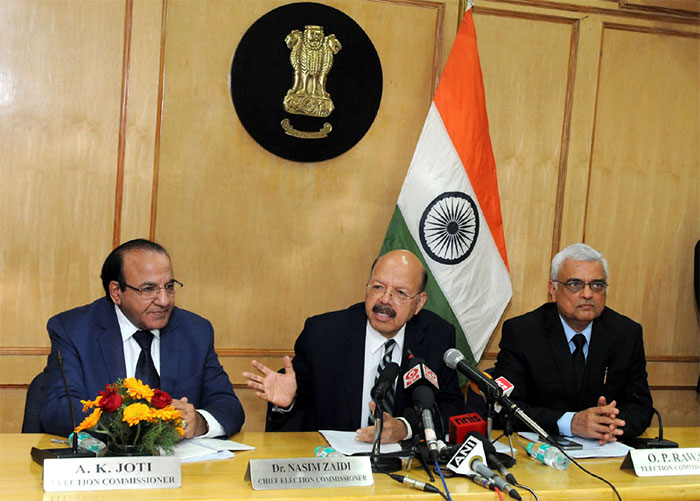
Announcing the schedule in New Delhi today, Chief Election Commissioner Nazim Zaidi said that around 17 crore voters had been enrolled for the Assembly elections (1.98 crore in Assam, 2.56 cr in Kerala, 5.8 cr in Tamil Nadu, 6.55 cr in West Bengal and 9.27 cr in Puducherry).
The electoral rolls of all the existing Assembly constituencies in the States of Assam, Kerala, Tamil Nadu, West Bengal and Union Territory of Puducherry had been revised, with reference to January 1, 2016 as the qualifying date, and published. During the Special Electoral Roll Purification Drive from February 15 to 29, 2016, concerted focus was laid on enrollment of all eligible voters, removal of repeated and multiple entries, removal of the entries of dead voters and correction of various types of errors in EPICs and roll data.
Mr. Zaidi said that the Commission had provided a symbol for the NOTA (None of the Above) option for the first time in this election. Voter verifiable paper trail would be used in ten Assembly constituencies in Assam, 12 in Kerala, 17 in Tamil Nadu, 22 in West Bengal and three in Puducherry. Photographs of candidates would be printed on ballot to be displayed on electronic voting machines and on postal ballot papers.
He said that the Commission would be taking a number of steps to improve voter experience. Basic minimum facilities such as drinking water, toilet and ramp for physically challenged would be made available in all polling stations. Model polling stations would be set up in all the constituencies as far as is practicable. Separate polling stations for women would be set up in areas where women feel inhibited in mingling with male members and also in large villages where two polling stations are being provided; generally with women polling personnel. Facilities for differently abled would be made available as far as possible. Auxiliary polling stations would be set up in blind schools and leprosy sanatoriums.
The Commission would be taking steps to ensure adequate security with deployment of Central forces in all polling locations. Steps would also be taken to check use of money power and paid news in the elections.
- Log in to post comments