Kerala signs joint venture agreement with railways
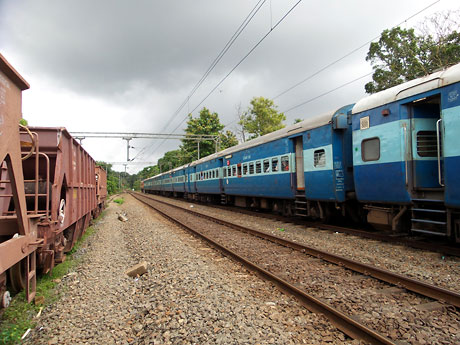 New Delhi: Ministry Railways and Kerala Government signed a joint venture agreement for development of railway infrastructure in the State here on Thursday in the presence of Minister of Railways Suresh Prabhakar Prabhu.
The agreement will cover projects such as, Sabari rail, railway coach factory, Kochi-Madurai line and other projects. Other projects to be taken up on a priority basis under the agreement include suburban rail between Thiruvananthapuram and Chengannur, Nilambur-Nanjangode line, Guruvayoor-Thirunavaya line and Thalassery-Mysore lane.
The Centre and State will have equity participation in the venture in the ratio of 51: 49.
The agreement was signed by S.C. Jain, Executive Director (Works) on behalf of Railways whereas it was signed by K.R. Jyothilal, Secretary, Department of Transport and Revenue (Devaswom) on behalf of Kerala Government. Chairman of Railway Board Ashok Kumar Mital, Member Engineering Aditya Kumar Mittal and other Board Members, and other senior officials were also present on the occasion.
Speaking on the occasion, Minister of Railways said that the signing of JV Agreements with the State Governments is a farsighted step of Ministry of Railways by which Railways want to work hand in glove with the State Governments for the development of railway infrastructure in the State.
He said that these kinds of JV Agreement are the best example of cooperative federalism for development of the nation as envisioned by the Prime Minister.
Mr. Prabhu pointed out that Kerala has been neglected for too long and now concerted efforts are needed to develop its railway infrastructure. He said that Railway Ministry has given maximum allocation to Kerala during 2014-15 to 2016-17. He further said that Railways is also working on the re-development of Kochi and Ernakulam Stations.
Speaking on the occasion, Chairman of Railway Board said that today’s JV Agreement would certainly fulfil the rail transport needs of the people of Kerala. He said that Railways want to extend railway network all over particularly in the States where demand is more and rail density is less. Railways have very limited resources and thus working in collaboration with the State Governments through JV Agreement can bring fruitful results for the people of the country.
- Log in to post comments