Kerala’s finances in black and white
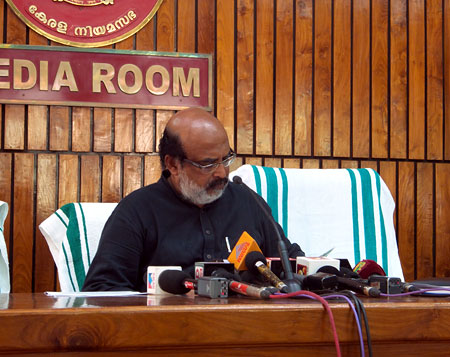 Thiruvananthapuram: “The State has been living on a financial lie,” declares the White Paper on State Finances tabled in Kerala Assembly by Finance Minister T. M. Thomas Isaac on Thursday.
The Paper accuses the previous United Democratic Government (UDF) of inflating Plan size and not providing for expenses in the annual budgets.
“In the process, unfortunately, budgets have lost their sanctity and budget speeches have become exercises in conjuring up unachievable visions of schemes and projects. The divergence between the reality and what is professed has reduced the annual budgets to a ritual of proclaiming a slew of real or imagined dreams and intentions.”
The UDF was vehement in denying the accusations. “It is a Black Paper,” said Opposition Leader Ramesh Chennithala. It is a ploy to paint the previous government black.
White papers on State finances are not new to Kerala. The Antony Government was the first to bring out a White Paper upon its assuming power in 2001. It had come to power after four years of rule by Left Democratic Front Government that saw Kerala plunging into the worst of financial crises.
The State had no cash balance worth the name from August 1997 and was continuously on ways and means advance from the Reserve Bank of India in 2000-2001. It had to avail overdraft from the Bank 25 times. Failure to clear the overdrafts had led to closure of treasury and bouncing of government cheques.
The White Paper listed outstanding payments and liabilities on various counts exceeding Rs. 4000 crore. They included items such as loans from cooperative banks (Rs. 643 crore) and bills payable to contractors (Rs. 829 crore).
Compared to that time, the position now is confortable though the figures are higher after 15 years down the line.
The White Paper (2016) lists immediate liabilities totalling Rs. 6302 crores and major unbudgeted short term liabilities totalling Rs. 4326 crore. However, some of these are amounts that are being rolled over every year at least for the past two decades.
It is notable that the UDF government that came to power in 2011 after five years of LDF rule had also brought out a White Paper. It had listed outstanding commitments causing immediate outflow of cash totalling Rs. 2154.90 crores such arrears in salary and pensions, outstanding payments to contractors and welfare pensioners and subsidies. It also listed additional financial liabilities totalling Rs. 10197 crore from commitments made by the previous government.
The liabilities mentioned in this year’s White Paper totals almost to the same amount—Rs. 10328 crores to be exact. The White Paper laments that it leads to the “distasteful situation of the new Government having to carry forward much of the liabilities”.
It may be recalled that there was a lot of campaign against the previous UDF and LDF governments over increasing debt of the government. The White Paper in 2011 had detailed the problems on this front. Now the debt stands at Rs. 1.5 lakh crores. The fact is that public debt has been more or less doubling every five years over the past decades whatever be the merits and demerits of the situation. Dr. Isaac is a votary of availing more debt to finance capital investment. However, the problem was that the loans were being used to meet revenue expenditure.
After 2001, white papers have become a means of campaign against the previous government. However, some of the accusations stick. Additional Resources Mobilisation measures announced in the last two years were only achieved to the tune of 75 per cent, leaving uncovered gaps in meeting Plan expenditure. Schemes were announced in the Budget that had no resources to finance them.
The Annual Plan size, the Paper reasons, was fixed about ten to 15 per cent beyond the State’s estimated capacity—all done to announce an artificially bloated plan size each year.
The growth of revenue from commercial taxes, which peaked at 24 per cent in 2011 when the LDF was in power, dropped to over ten per cent by 2016. If a simple average is taken, commercial taxes grew by 10.31% between 2001 and 2006, 17.75% between 2006 and 2011, and then declined to 14.26% between 2011 and 2016. This resulted from under performance of tax collection machinery in general between 2011 and 2016. The government issued stays on collection of large amounts of tax and concessions offered to benefit certain groups of tax payers. There was also wilful default in tax collection.
Consequently, the growth rate of commercial tax revenues lagged behind the economic growth of the State between 2011 and 2016, especially during the last three years of UDF government.
Noting that there is no shortcut to fiscal consolidation, the present government proposes to gear up the tax machinery to achieve annual growth rate of 20 to 25 per cent in tax collection. The government is also to exercise strict expenditure control.
The Paper proposes to innovatively adapt the legal framework for existing institutions and create special purpose vehicles wherever necessary for implementing major capital projects on a massive scale. This was an idea projected by Dr. Isaac when he was the Finance Minister last time though that did not make much headway at that time. But, he promises to unfold his mix of strategies in the revised State Budget to be presented on July 8.
K. K. Krishnakumar, Fellow of Centre for Socio-economic & Environmental Studies, Kochi, said that fall in growth rate of State’s tax revenue and its failure to keep up with economic growth was an alarming situation. A transparent system of tax administration introduced by the LDF government was weakened by the UDF government. “Concessions were given to individuals. Nepotism and corruption may be involved in this.”
He said that the fall in prices of rubber and remittances from abroad would also have affected tax revenues.
He doubted whether the new government would be able to double the tax growth rate. However, Kerala will benefit from Goods and Services Tax, if introduced. Certain benefits also accrue to the State from award of 14th Finance Commission.
Former Chief Minister Oommen Chandy disputed the observations in the White Paper and said that the total revenues had not come down. “If non-tax revenue is added, it can be seen that the government’s performance in the last five years was a record performance. But, the White Paper left out non-tax revenue.”
K. M. Mani, who was Finance Minister in his government, maintained that the then government had to give concessions to various categories in view of global recession. “The UDF government put up its best possible performance within the constraints of that time,” he said. Dr. Isaac is in no mood to agree.
- Log in to post comments