Anger, fear in Kerala over brutal murder of law student
Thiruvananthapuram: Once again the question of safety of women has become the subject of debate. The wild incident that victimised the law student at Perumbavoor in Kerala has once again created ripples among the general public.
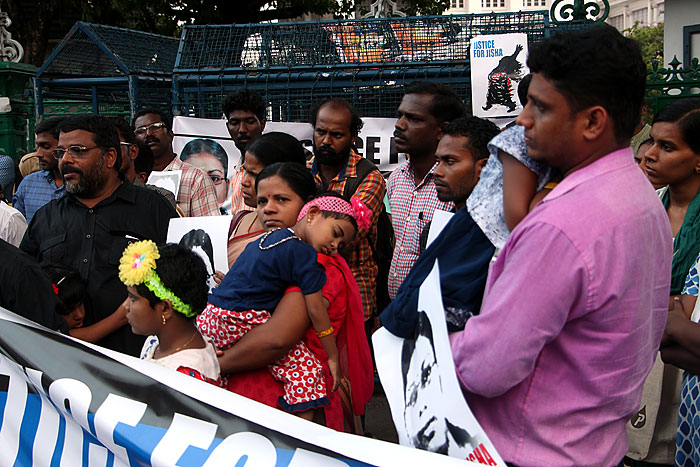
Protests have erupted in Ernakulam where she studied and the neighbouring Sree Sankaracharya University of Sanskrit, Kaladi. A march was taken out to the office of the Inspector General of Police (Kochi Range), Ernakulam.
The capital of Kerala, Thiruvananthapuram, also witnessed protests by different groups including a facebook group demanding justice for the victim. The BJP as well the women’s wing of the CPI (M) — All India Democratic Women’s Association, also organised protests.
Many pointed out that the dalit background of the victim, her poor background and condition of her mother led to the case failing to get much media attention or proper investigation by the police for the first five days. The police have now assured the protesters that proper investigation would be done. The National Human Rights Commission has taken suo motto action and sought report from the State government.
It was not long ago that a woman who was travelling by train in the evening to reach home was thrown out of the train and brutally raped and murdered. A dalit girl became a victim of mass rape near Attingal in Thiruvananthapuram district recently. Discussions debates suggestions and amendments have done their part quite seriously from Nirbahya to date in recent history. But history repeats, turning worse than before.
“We have numerous laws to protect women in this country. Her birth itself starts with the protection of PCPNDT Act, 1994 where sex determination is banned by law to protect the girl child. At all stages of a women s life law supports her. It is not the absence of laws to prevent crime but various other factors that contribute to repetition of such incidents,” says Dr. Bismi Gopalakrishnan, Associate Professor at the Department of Law, University of Kerala.
The issue, she adds, starts with the registering of the case, the demoralising attitude of the public servants, the social attitude to the victims and their families, the delay in the delivery of Justice and the loopholes in law that allow political or influential interference in the discourse of the case are what prevents the effective implementation of law to get a desired result. The deterioration of value systems due to technological advancements and free accessibility to pornographic videos and video chats through mobile devices results in brutal mentality of such maniacs.
The news of the student’s murder was main topic of discussion in the University campus with both men and women discussing the reasons and possible solutions. They raised their concerns under the banner of Students Federation of India and organised a public meeting to condemn such heinous crimes.
Federation unit secretary V. V. Ajeesh comments that even in Arabian countries with stringent laws, incidents of rape are not rare. So it is not the absence of law or the implementation but the attitude of society and its sexual outlook that needs to be addressed.
“A man’s sexual needs are aroused as early as a teenager but he is forcefully suppressing his physical needs due to social pressures. This needs to be addressed also sex education should be given at an earlier age and gender equality must be fed into new generation through proper redress of this issue right from school level.”
Protesters who gathered at the Secretariat were small groups but a few had come travelling more than 50 km. One couple had come, carrying their children. Dinu Sekhar, an electrical engineer, said that the poor should be provided with better housing and environment. “We are afraid that the same things can happen in our homes too. We had started from similar backgrounds. My sisters, children and relatives should be safe.”
Seeta Dasan, who has hails from a fishing locality on the Thiruvananthapuram coast, differs. “The problem is not that the homes are not safe. It is that the women are not safe.”
She adds: “the situation is terrible. The police have become scare crows as drug abuse proliferates, environment is degraded and women are raped.”
S. Sajeevan, a software engineer who came to the protest in response to a call by a facebook group, lamented: “Though everybody is protesting, hardly anyone is suggesting solutions.”
Rape is no act of simple sexual satisfaction that was a momental spur. It is a cruel and inhumane act that shakes normal human mind. It genuinely raises the question of a psychological dimension to this issue.
Dr. S. Raju Head of Department of Psychology, University of Kerala, asserts that such incidents are purely of a psychological nature. Rapists belong to the category of people with deviant sexual behaviour that needs to be corrected. He shared an incident of a sexual worker who was brutally assaulted by her clients in the neighbourhood. It is a psychological behaviour that can be corrected through aversion therapies. The minor in the Nirbhaya case if not psychologically corrected with recommended treatment is prone to repeat the same crime.
(With inputs from Rajeena Aysha)
- Log in to post comments